Mother Tongue · Advanced learners
For students who use Chinese at home and are ready for advanced reading, writing, and literary appreciation. Depth and difficulty rise according to ability.
G1–G5 progression
To learn a language is to step into another culture, and to gain another way of thinking and of saying what you mean. At RDAS, World Languages let children discover a wider world by providing them with new perspectives and access to new people, thoughts, and works of art.
RDAS language teachers adapt to each learner in the classroom, and teach with methods grounded in cognitive science.
Level 1
First, students are placed by starting point, so each one begins at the right level.
Level 2
Layered support within one classroom. Teaching flexes to each student.
Level 3
Content is pitched within reach, but only on tiptoe.
Level 4
Every unit ends with a real project that puts the language to use in a meaningful context.
Language 01
The three tracks are fully independent, each with a complete curriculum, dedicated materials and internationally recognized benchmarks. A child who later moves to another school or country carries Chinese that maps to a clear standard, with no need to start over.
For students who use Chinese at home and are ready for advanced reading, writing, and literary appreciation. Depth and difficulty rise according to ability.
G1–G5 progression
For students with some Chinese who need systematic consolidation and steady progression.
G1–G5 progression
For students learning Chinese for the first time, starting from zero and building a base step by step.
G1–G5 progression
Tracks reflect where a student starts, and each one has its own curriculum, written for that level.
Elementary school builds the base in listening, speaking, reading and writing, and middle school and high school extend it step by step. Example middle-school Chinese learning goals:
Read longer and more sophisticated texts.
Translate short passages on a range of topics into the language of instruction
Infer the meaning of some unfamiliar words or language, including longer sentences, from context
Understand longer passages or conversations spoken clearly at near-normal speed with some unpredictable content
Infer the meaning of some unfamiliar language from context and tone
Take brief phonetic notes using familiar characters, conveying meaning accurately
Ask and answer confidently and spontaneously on a wide range of topics using correct sentence structure
Sustain longer improvised conversation on familiar topics, coping with unexpected questions
Make themselves understood in Chinese in almost all classroom communication
Express their own and others’ ideas and opinions with reasonable precision
Write a coherent short text of about a paragraph on several familiar topics
Apply Chinese syntax when writing, and explain how it differs from their native language
Recall and use around 30 verbs
Handle a range of structures independently, including negatives and superlatives
Use correct word order consistently in questions and statements
Recognize the meaning of a range of non-cognate words covering abstract and concrete concepts
Write familiar Chinese characters from memory consistently
From Pinyin in G1 to confident use in middle school: one continuous Chinese path, all the way through.
Systematic Planning · International Standards
From elementary through high school, RDAS language courses are planned as one continuum across grades, not improvised semester by semester. Chinese begins with Pinyin in elementary school and advances step by step, connecting to higher goals in middle school and high school — coherent across every stage.
The curriculum is benchmarked to each language’s authoritative standards and to internationally recognized frameworks such as HSK, YCT and ACTFL. A student’s level therefore maps to clear standards, and progress can be measured and tracked.
For parents: if your child later transfers to another school or country, these competencies map to widely recognized standards — so your child doesn’t have to start from scratch.

“Every teaching activity has a clear objective and sits within a long-term plan. From early introduction in elementary school to confident use in middle school and high school, each part follows a complete sequence.”
RDAS Language Curriculum Design Principles
Differentiation for Every Child
Classroom example · Chinese character-writing
Most students practice strokes and characters in a writing workbook.
For elementary students who need more support, teachers provide craft materials so they form the same character by collaging and building.
Both routes land in the same place.

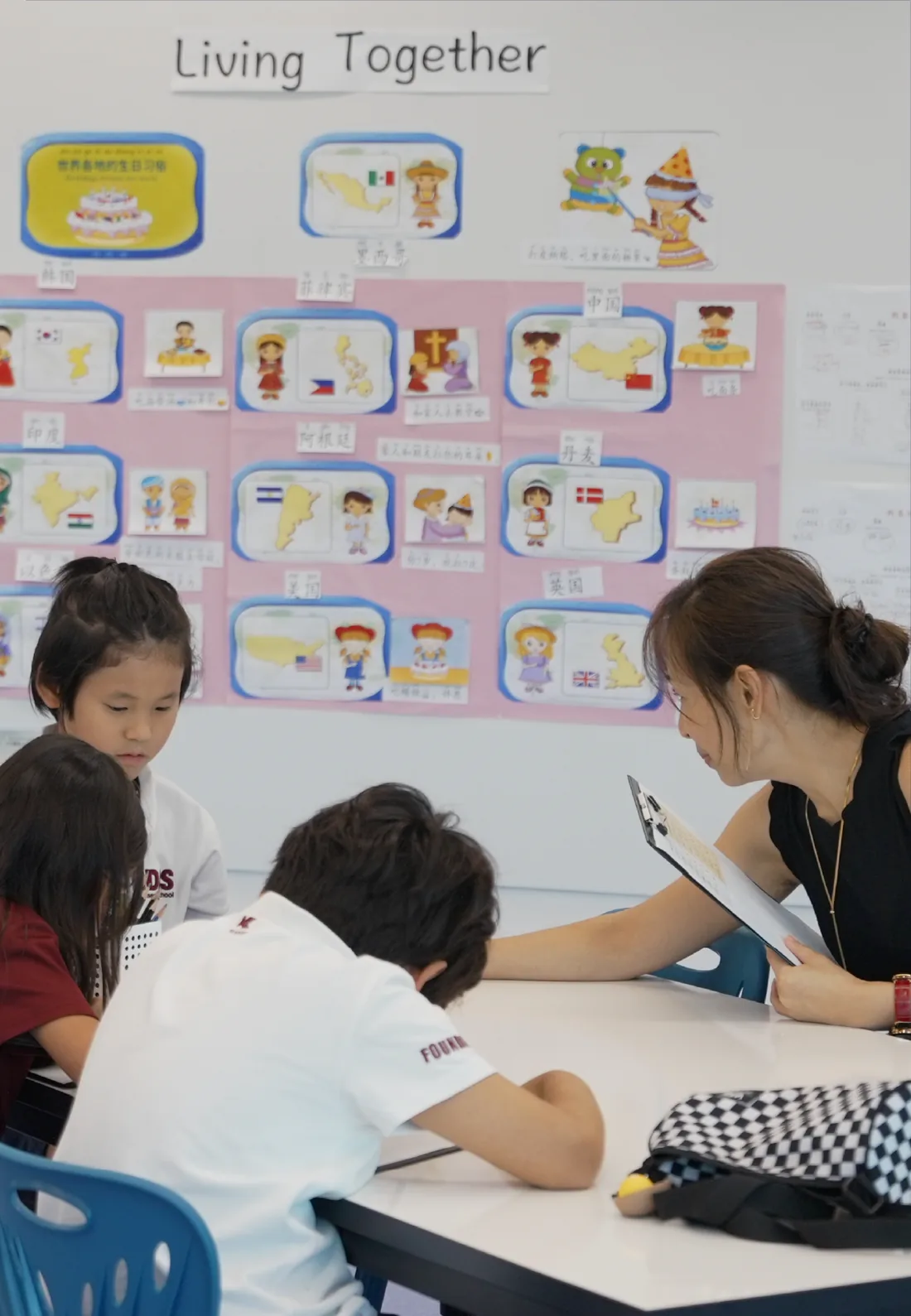
Language teachers adapt instruction to students’ abilities and interests. This approach relies on RDAS’s low student-teacher ratio: with small classes, teachers can observe each student closely and prepare materials or adjust methods as needed.
In the elementary years, interest is a key driver of learning. RDAS language teaching is grounded in cognitive-science research:
Each lesson is set one notch above the student’s current level, requiring some effort to reach. Success that repeats is what keeps a child trying.
Basis: Vygotsky’s ZPD · Krashen’s i+1
Through project-based learning, students gradually master planning, doing, and reflecting, developing ownership of their learning that carries beyond the classroom.
Basis: Self-Regulated Learning
Each unit consists of two parts: the first builds linguistic and cultural knowledge; the second applies that knowledge in real contexts.
Basis: Project-Based Learning
The examples below show how elementary students put classroom Chinese to use: observing, researching, explaining and presenting. Each centers on a real task.

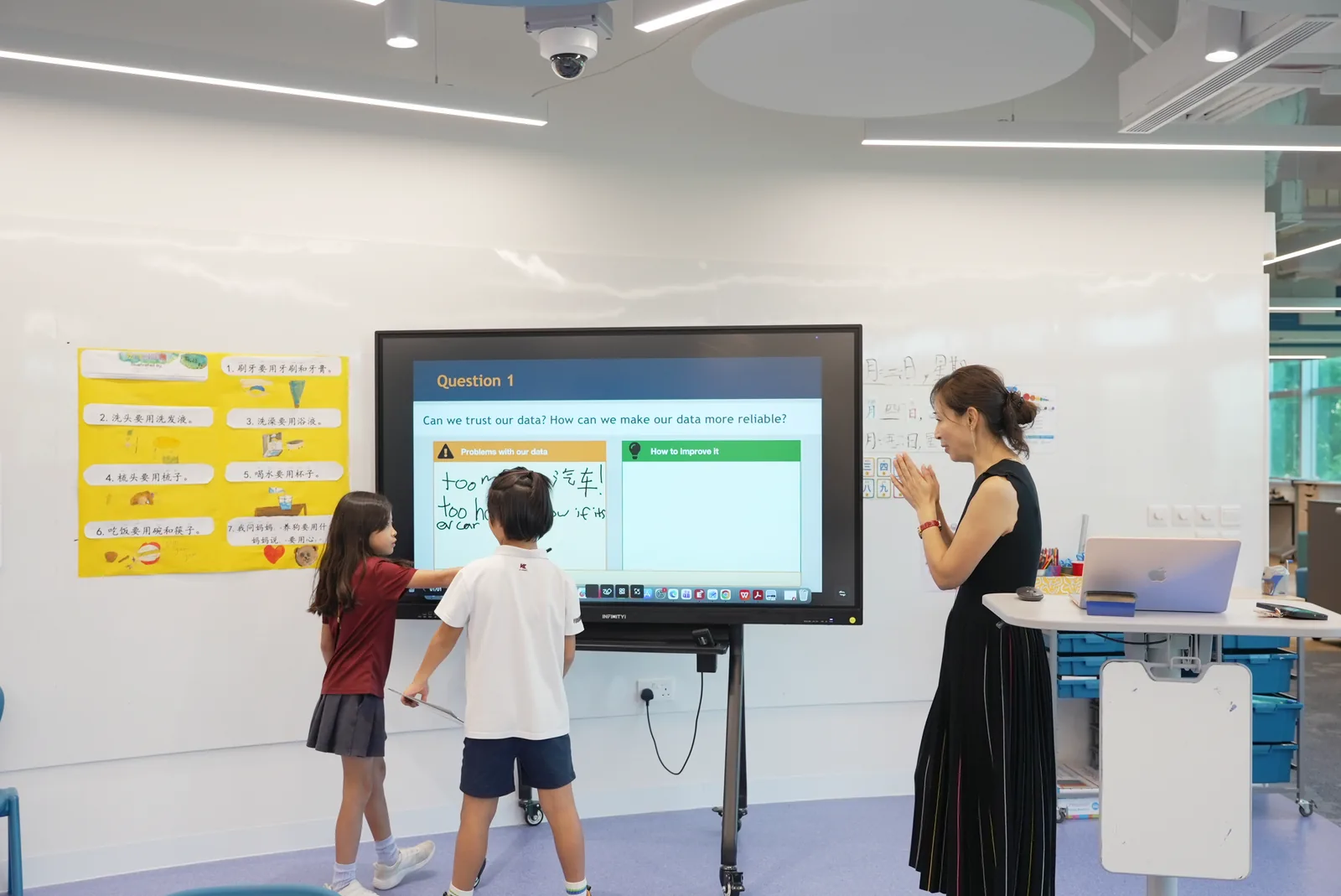
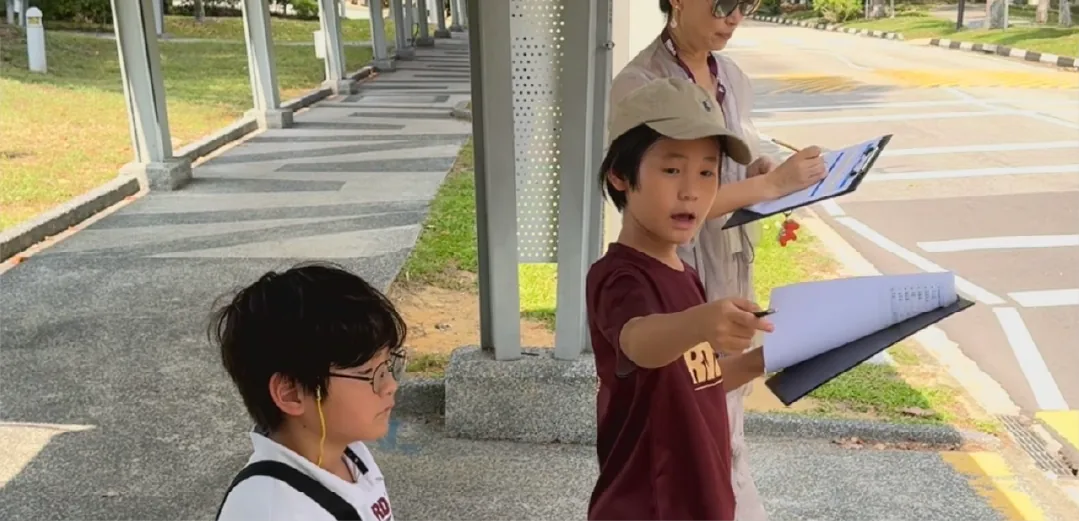
After learning vehicle vocabulary, students head to a street near campus for fieldwork: using an observation sheet, they tally the vehicles passing in half an hour, then return to organize and analyze the data and report to the class. A follow-up discussion asks whether the data is objective and how more electric vehicles affect the community.

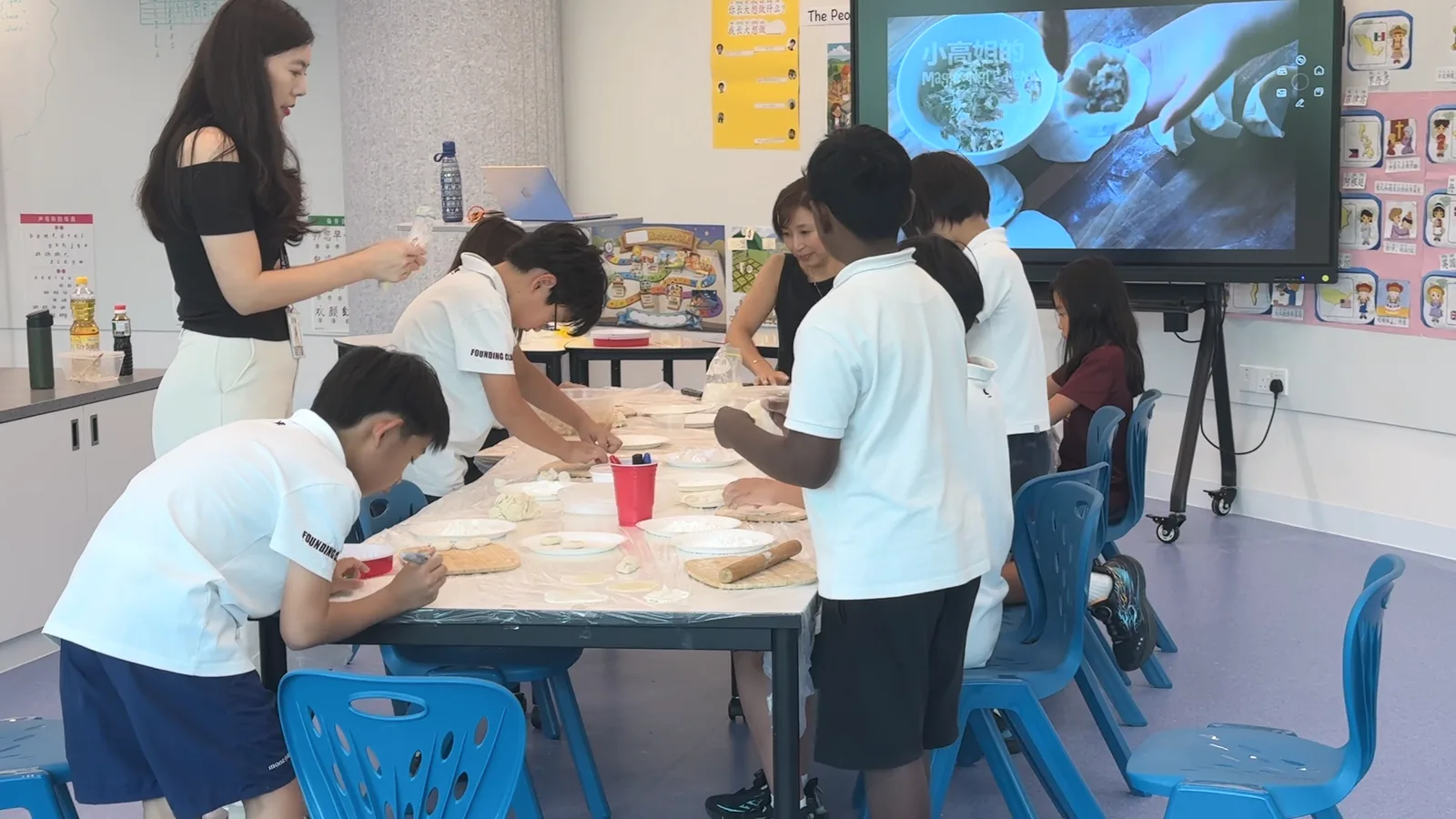
In the “Food” unit, students introduce a dish from their own country in Chinese. While practicing food vocabulary and sentence patterns, they bring their own cultural background into the classroom, creating genuine cross-cultural exchange. This reflects the two-way exchange in RDAS Chinese lessons: introducing Chinese culture while encouraging students to express their own country’s culture in Chinese.

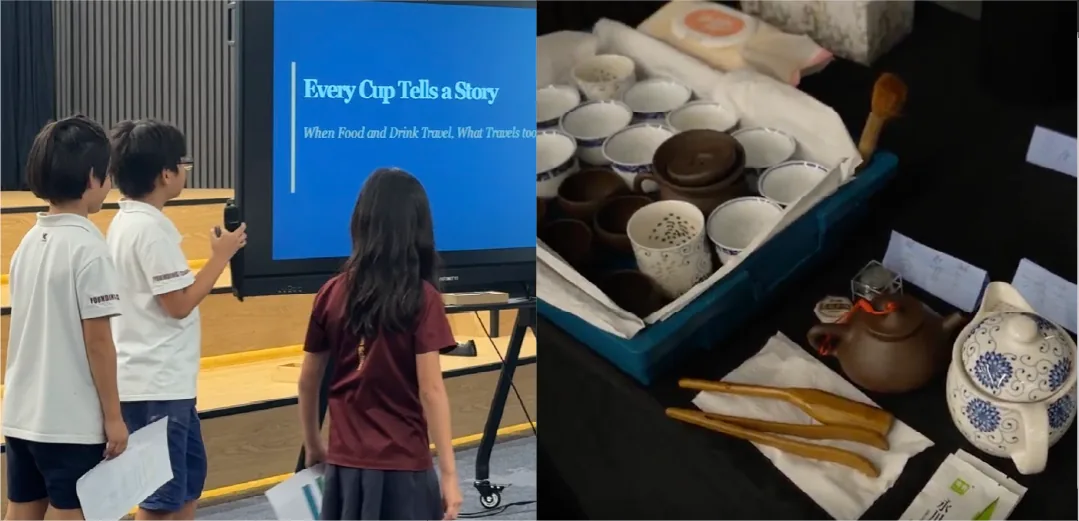
Using the picture book Lulu’s Chinese Tea, students read and discuss the idea that “every cup of tea has a story,” combining Chinese reading with cultural inquiry, understanding the story while learning the culture behind tea.

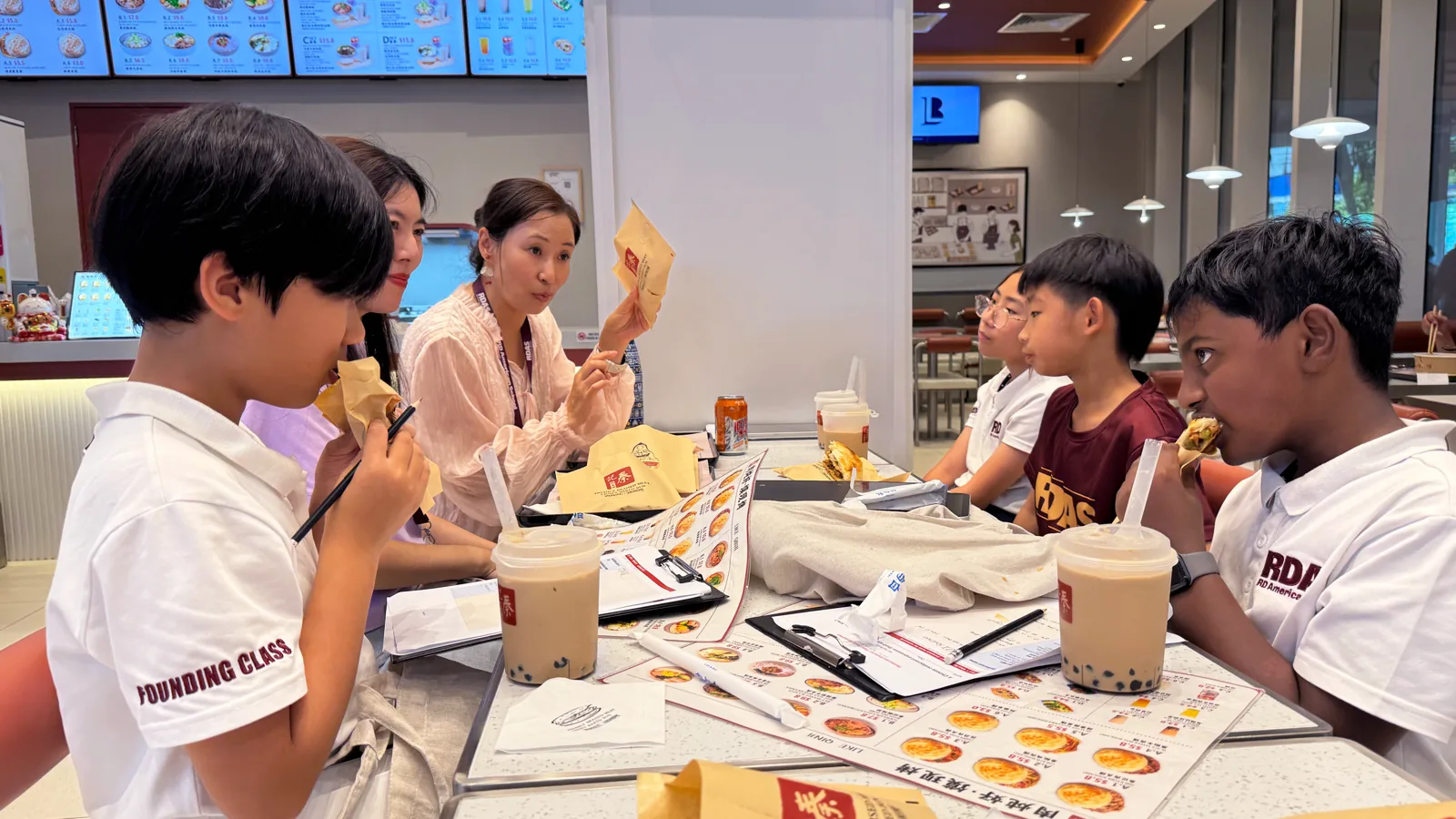
Students visit Changi City Point for a field study, researching and presenting in Chinese how a restaurant conveys its identity through space and decor. The full cycle runs from preparation and on-site research to a written report and a presentation, with students using Chinese to observe, record and explain what they see in a real setting.
Elective · Language 02
We plan to add Spanish to our world language options when we open the high school. Spanish will be offered as an additional language option to our middle and high school students, alongside Chinese, taught with the same approach and held to the same high standards.
RDAS World Languages runs across every grade and is benchmarked to international standards, with small class sizes that keep every child in view. Beyond language, explore our music and art programs, and meet the teachers behind these classrooms.