Hold your attention on the speaker; let your reply wait.

English class at RDAS asks for more than grammar and reading comprehension. We learn to listen for an author’s purpose beneath the rhetoric, hold a position and change a mind, and write something a reader will remember, either for its beauty or its impact.
English class is, at its core, a place to refine the four fundamental skills with which we communicate: reading, writing, listening, and speaking. We listen so that we may speak better; we read so that we may write better. Listening and reading help us understand how many different cultures and people there are around us; writing and speaking help us be better understood and give us the tools to send our ideas into the world and, in doing so, change it.
Strong readers are built by range and by rigor. Our students move across eras and cultures, through fiction and non-fiction, poetry and drama, journalism and speeches. We teach students to read in a way that weighs both how a text works and what it says.
Read a text twice: once for what it says, once for what it’s doing.
Ask what the writer wants you to feel, and by what means they achieve it.
Hold a claim up to the light: what’s the evidence, and what’s missing?
Carry a question out of one book, and into the next.
Most people picture listening as sitting quietly, waiting for a turn to talk. Real listening asks for far more. A child who listens actively holds their attention on what is being said, reads the speaker’s tone and the feeling behind the words, holds back a quick judgment, and answers the point that was actually made. In every discussion and debate at RDAS, students are taught to listen this way, because listening well is the quiet engine behind speaking well.
Hold your attention on the speaker; let your reply wait.
Paraphrase a classmate to make sure you understand before you push back.
Read the tone, and the feeling behind the words.
Ask a question that opens a point up, then build on it.
Someone says this in a discussion. Which reply actually listened?
Great writing reads as if it simply fell onto the page. It never does. Every line is built from choices, and our students learn to make those choices with care.
In English, a dozen words can all mean “to shine,” and no two of them mean quite the same thing. The right one puts an exact picture in a reader’s head. Finding the right word draws on a vocabulary built over years, the kind of range our students build one word at a time.
HoverClick a word to see what it really means.
Pick the wrong one and the picture blurs. Pick the right one and the reader sees clearly. It runs both ways: the precise word sharpens the image in the reader’s imagination, and a writer’s eye for detail pushes them toward a still more precise word. It becomes a loop. Reach for finer language and your senses have to sharpen, until you start noticing a world you used to walk straight past.
Each kind of writing does a different job, and our students learn to move between them and choose the right one for their purpose.
Narrative
to make a reader feel they were there
Argument
to change what a reader thinks
Analysis
to show how a text, or an idea, actually works
Explanation
to make something complicated clear
Poetry
to make a few words hold what a paragraph cannot
Reflection
to think on the page and find what you mean
Speaking well is more than a single skill. It is a set of strategies that shifts with your purpose: everyday talk demands precision, so nothing in the message is lost; a presentation draws on the power to move a room and build a public presence; a debate sharpens logic and critical thinking; a negotiation focuses hard on the point until both sides reach agreement. It is thinking, stacked one layer at a time. This is oracy, the skill of speaking well and being understood. Whichever form it takes, speaking well runs on the same four essentials:
Voice
Fluency, pace, tone, and projection.
Language
The right word for the moment, the right register, and rhetoric used on purpose.
Thinking
Choosing what matters, ordering an argument, and building on what others said.
Poise
Reading the room and holding it with your eyes, taking turns, listening closely, and staying steady under pressure.
Read a demanding text, identify its central claim, and weigh the evidence behind it.
Identify a writer’s techniques and explain how those choices move a reader.
Distinguish among fact, opinion, and spin, and judge whether a source is credible.
Move between fiction, poetry, journalism, and data, reading each on its own terms.
Follow a talk, grasp its argument, and recognize the speaker’s stance.
In a debate, restate an opponent’s argument and answer it with reasons.
Tell a well-grounded claim from one that is merely persuasive.
Follow a long discussion and pinpoint where the disagreement actually lies.
Shape the same material into a story, an argument, or a review for a specific reader.
Use metaphor, rhythm, and well-placed silence deliberately.
Write in a voice that is unmistakably their own.
Carry a piece from rough draft to finished work.
Command the grammar and conventions of standard English when the occasion calls for it.
Prepare and deliver a speech, from first idea to the stage.
Argue a position, field a hard question, and rebut without losing the thread.
Persuade a skeptic and negotiate a path through disagreement.
Suit their language to the room, from one classmate to a full audience.
Recognize how tone, body language, and rhetoric shift meaning.
Recognize the era, the culture, and the position a speaker argues from.
Compare multiple sources and judge what is reliable and what is relevant.
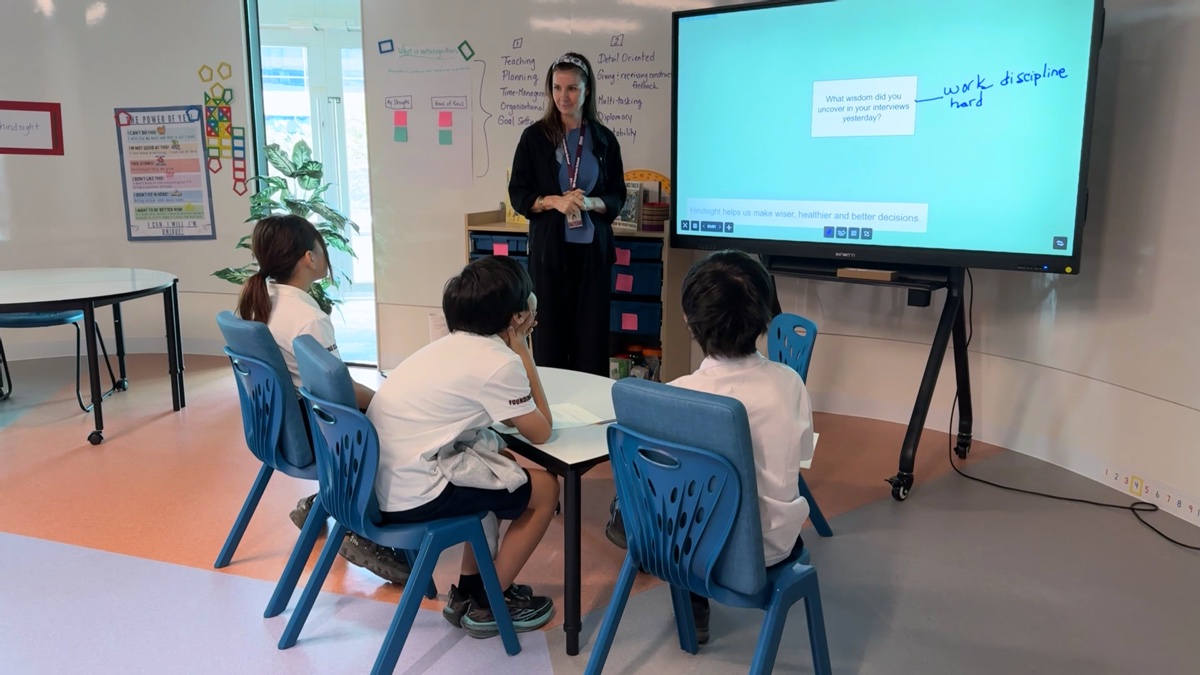
For students whose first language isn’t English, RDAS runs a flexible EAL program (English as an Additional Language): specialized courses build their foundational language skills, while electives and specials let them put those skills to use in PE, music, and art, alongside native-speaking classmates.
Here, no one is a bystander, and no one is left feeling out of place.
We believe language is never a tool a child has to finish learning before they can use it. Every day, they learn by using the language, and use it as they learn, so that language and confidence grow together from their very first day on campus.
Explore our EAL program