
Our Art Classroom

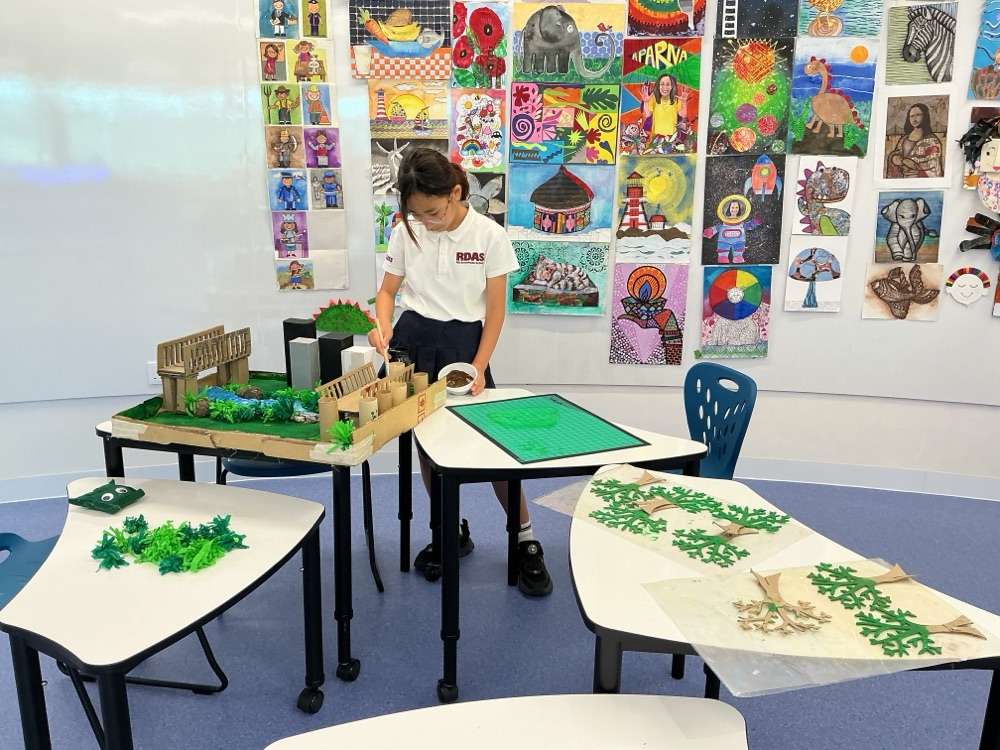
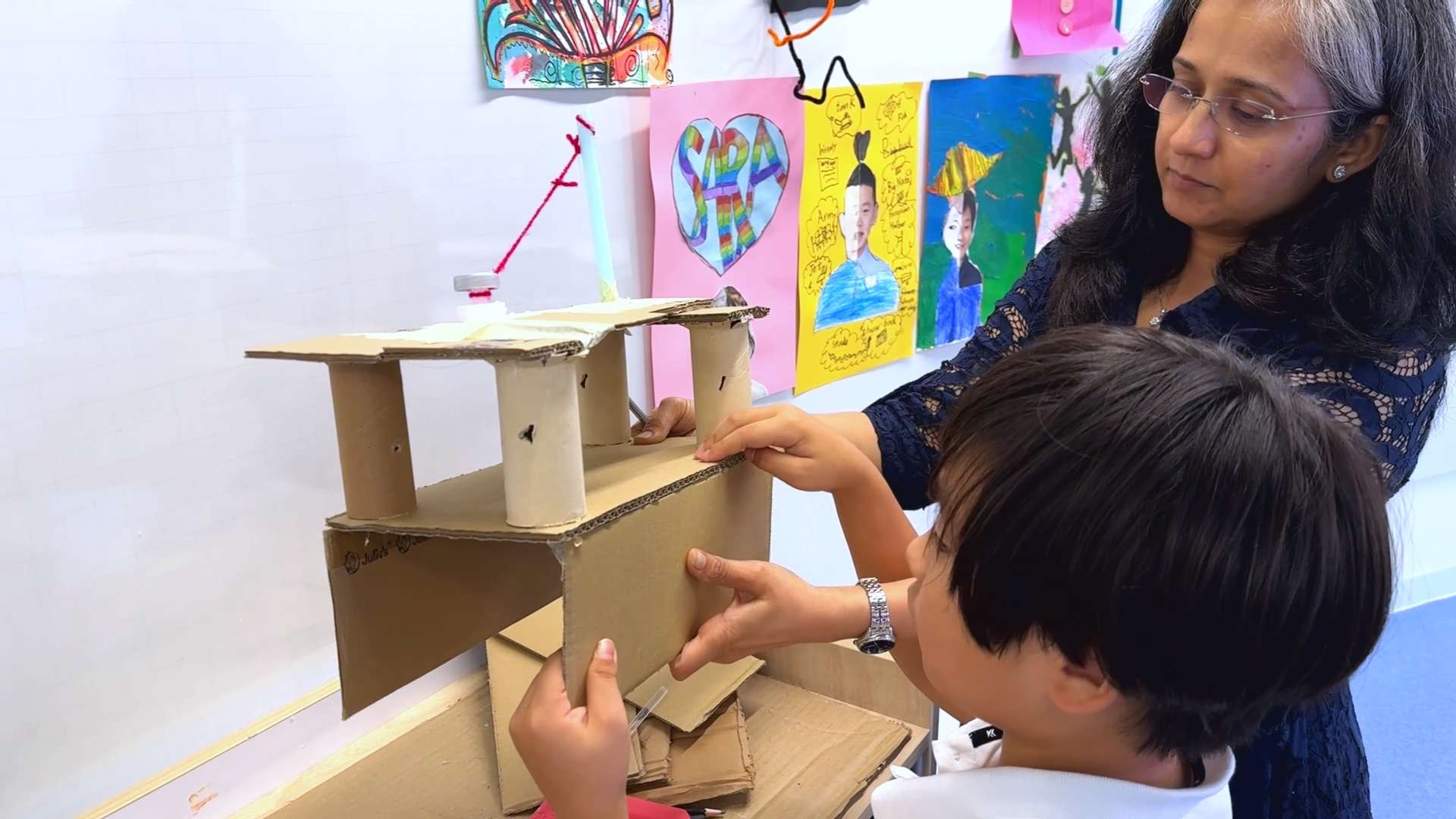
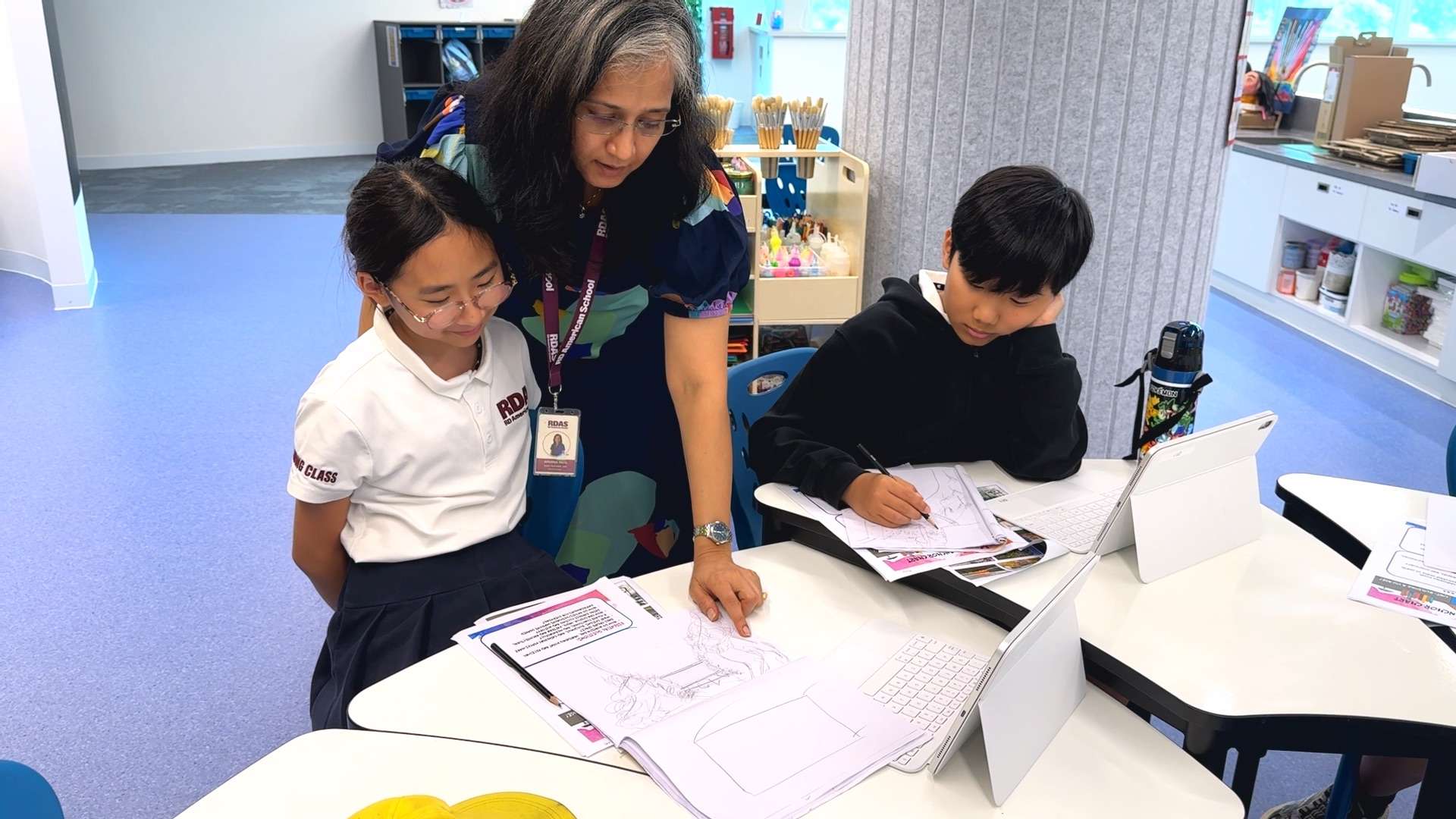
Step into our Visual Art room and you’ll find children absorbed in making: drawing, constructing, painting, layering. What you see is genuine creative engagement. What you can’t see is how carefully the room has been built around them: a sequence of activities drawn from cognitive science and emotional intelligence, and from the conviction that every child has something of their own to say and can be taught to say it. This page takes you through the parts of the lesson you would never notice from the doorway, the ones that decide how much a child actually learns here.

The visual arts program at RD American School (RDAS) runs as one continuous journey from elementary through high school, built on four foundations: color, line and shape, form and space, and texture. In the first half of this page we use the elementary classroom as our example: how we teach, and what children learn. Further down, the growth map spans elementary, middle school, and high school, so whatever stage your child is in, you can see how the path unfolds.

The Invisible Design Inside An Art Lesson

The following practices occur in every lesson, across every grade level. They decide whether learning stays on the surface or goes deep.

Every Visual Art lesson at RDAS follows an intentional sequence, one that places the child’s cognitive and emotional readiness at the center before any artistic task is introduced. It is how the research shows up in an ordinary art lesson: spaced retrieval practice, metacognitive development, and learner-centered pedagogy, all built into the shape of the hour itself.

Connection Before Creation

“Before a mark is made, a connection is established.”

Learning does not begin the moment a child sits down. It begins at the door. At RDAS, each student arrives at the art room and is invited to choose how they would like to be greeted by their teacher. The practice comes out of relational pedagogy: a child who feels seen and acknowledged feels safe, and a child who feels safe will take a creative risk and stay with the work.

Handshake
Fist bump
High five
Wave

It is a small gesture, and it changes a great deal. Before a mark is made, a connection is established.
The Child First, Then The Art
Emotional Check-In

Children arrive from different classes in different states: some ready, some restless, some carrying something heavier. Before any art-making begins, students check in using our classroom Mood Meter, a four-color tool that helps each child put a name to how they are feeling right now.

“I want to make sure they come in with a good state of mind.”

Every Lesson Begins By Remembering

Each lesson opens with retrieval practice. Actively pulling knowledge from memory is one of the most effective ways to make learning last. Pulling back even one idea makes everything around it hold far better.

“It might be just one sentence, but it makes the learning very strong.”

The Real Subject Is Identity

Here, an artwork is always a child answering: what do I notice, where am I from, what do I want to say? Students are never directed toward a predetermined outcome. The curriculum sets up the conditions; what fills them comes from the child.

“An artwork is not just art. It’s a complete learning experience.”

Slowly: Quality Over Quantity

Techniques are introduced one at a time, practiced across spaced sessions, and regularly retrieved. A student given time to truly master a technique develops something beyond competence: sound judgment. They know how to use a skill, and they know when it serves meaning and when it does not.

“Making art is not one lesson. It’s a process.”

The Mindset We Build Together

Every period opens with two anchoring beliefs, one from the world of art, one from the science of learning. They set the standard for this classroom: that effort matters more than outcome, that process matters more than product, and that the courage to try is the most important skill an artist can develop.

Four Things Go Deep, And Become A Way of
Seeing, Thinking, and Making

Line, color, form, texture: the foundations of visual art. They deepen year by year, and they leave a child with a sharper eye, a bolder hand, and the ability to turn an idea into something real.

01 / 04

Color

Color is the most instinctive element a child reaches for, and the least understood. At RDAS, students mix every color they use from scratch. From the first mix of red and yellow to a deliberate monochromatic composition in the upper grades, color evolves from a feeling into a language, one the student learns to speak with increasing precision and intention, and in a voice of their own.

In the early grades, color is explored freely. In the middle grades, the question moves from “what color?” to “why this color?” as students learn how hue carries mood and guides attention. By the upper grades, every color choice is deliberate and conceptually motivated. A child who has mixed a color knows it. We call this the shift from using color to knowing color.

Foundation Grade 1

Color introduction and exploration

Primary, secondary, warm, cool: color begins as instinct. The question a student learns to ask shifts from “what color?” to “what does this color say about me?”

Building Grades 2–3

Color with purpose

From tertiary colors to monochromatic study, tints, and shades: students move from using color freely to using it deliberately. The guiding question shifts from “which color do I like?” to “which color serves this work, and why?”

Applying Grades 4–5

Color as voice

Color theory becomes a tool. Students apply gradient, shade, tint, and hue across line, form, pattern, and texture to express a personal and intentional artistic voice. The standard is simple: every color chosen must have a reason.

A little game from the classroom · Mix it

Mix A Color Of Your Own

tap paints to add them
empty palette

Why let children mix their own colors? Color has to be made: red plus yellow makes orange, a touch of white softens it. Only by mixing it themselves do children really understand color, moving from “using color” to “knowing color.”

02 / 04

Line & Shape

Line and shape are where drawing begins. Over the years, students go from marking simple lines, to seeing lines everywhere (a railing, a shadow, a letter on a sign), to bending line and shape to say exactly what they mean.

Drawing starts with scribbles, moves on to the different kinds of line, then joins them into shapes. It looks like free play, and it is building the hand–eye coordination and fine motor control that a child keeps for life.

Foundation Grade 1

Lines and shapes

A straight line, a curve, a zigzag: each carries a different energy and tells a different story. Students discover how lines become shapes, and how shapes connect to the world around them: a rooftop, a leaf, a wheel in motion. Making is how a child first learns to read the world.

Building Grades 2–3

Line in the real world

Through typography, lettering, and layout, students discover how far line reaches beyond art. Every letter, every logo, every road sign is built from line with intention. Recognizing that transforms how a student looks at the world.

Applying Grades 4–5

Line as identity and personal voice

Soft, sharp, wavy, broken, crosshatched: different lines carry different feelings, and students weave them into a composition to say what they mean.

A little experiment from the classroom · Try it

Blind / Contour Drawing: Draw A Cat Without Watching Your Line

In a fifth-grade art class, the teacher had children keep their eyes on the subject the whole time they drew. Try to copy the cat on the left onto the blank space on the right. Hit “reveal” to show your blind drawing.

the subject
your paper (hidden while you draw)

Why hide your own line? When we draw, the eye unconsciously corrects the hand in real time. The mark ends up looking accurate through constant small adjustments, while the looking itself stays shallow. Blind contour drawing removes that safety net entirely. With the line hidden, the student has only one resource: genuine, sustained attention to the subject. When the drawing is revealed, the gap between assumption and reality becomes visible, and that honest confrontation is where real learning begins.

03 / 04

Form & Space

The widest journey: from telling flat shapes from solid ones, to understanding three-dimensional work and building it, to placing it in real space.

Spatial awareness develops fast in these years, the best time to introduce composition, perspective, and building in three dimensions.

Foundation Grade 1

Lines to shapes

There are many kinds of line, and lines build into shapes. Shapes, in turn, connect to one another to make patterns, objects, and pictures that tell a story.

Building Grades 2–3

Lines, shapes, and form

In Grade 2, students move beyond drawing lines to using them with purpose, discovering how line builds pattern, creates texture, and becomes a tool for visual communication. Shapes are explored in their two forms: organic, as found in nature, and inorganic, as found in the structures and objects of everyday life. Recognizing both in the real world sharpens the student’s eye and deepens their understanding of the world around them. This knowledge is then carried into three dimensions, as students begin to explore how flat shapes transform into solid forms, connecting what they see on paper to what exists in the physical world.

Applying Grades 4–5

2D, 3D, perspective, and geometric connection to the real world

This is where art and analytical thinking converge. Students investigate the geometric foundations of real-world structures, explore the rules of perspective that govern how we perceive space, and move between two-dimensional and three-dimensional thinking with growing fluency. The world outside the classroom becomes both the subject and the proof.

A little experiment from the classroom · Drag it

One Length Of Yarn Finds The Vanishing Point

To teach the vanishing point, the teacher skipped the definition and simply stretched a length of yarn down the hallway, inviting students to observe from one end. Every parallel line converged toward a single point in the distance. What they saw, they understood immediately and permanently. Below, drag the orange dot and watch every line rush toward that one point, and see for yourself exactly what those students saw.

drag the orange dot up toward the horizon

The secret of perspective: only the direction of the lines changes, while the object itself stays the same. When parallel lines converge toward a single vanishing point, a flat surface gains depth, distance, and dimension. Perspective arrives all at once. The moment a student sees that depth is something they can draw, it stays with them. In one lesson, a child looked up and said, “That’s the vanishing point!” Unprompted, certain, and completely right. That is the kind of learning no worksheet produces.

04 / 04

Texture & Materials

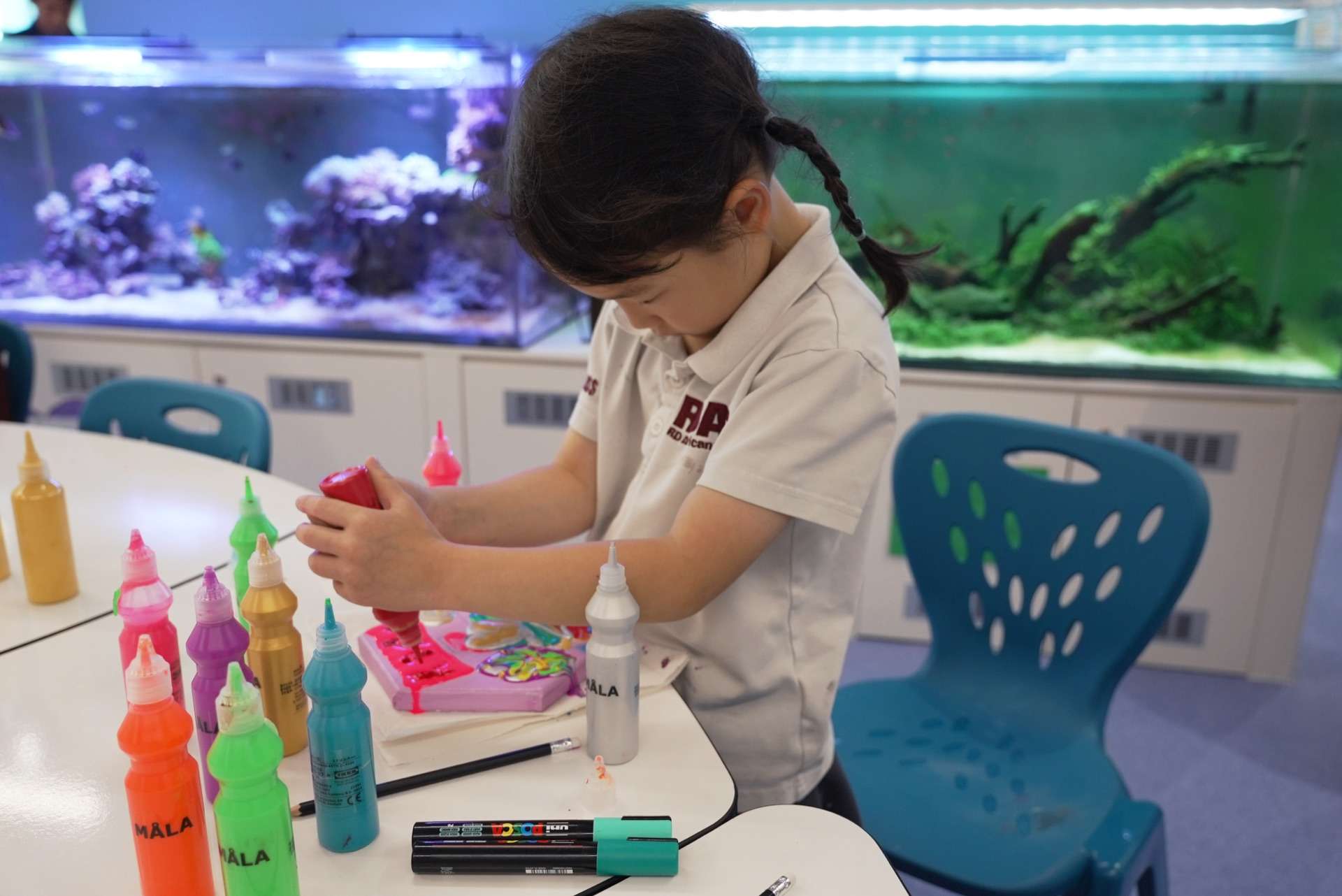
Texture begins with the hands: feeling, touching, discovering. It grows into a deliberate artistic choice: selecting materials with purpose, layering them with intention, and building works that carry both visual depth and physical presence. At RDAS, students source their own recycled materials, because the most meaningful art is made from the world the child already knows.

Every material handled is a problem posed and a skill built. The wider the range of materials, the more a child has to think about, and the more their hands can do.

Foundation Grade 1

Feeling texture

Before texture is understood, it is felt. Smooth, rough, bumpy, soft: students discover through their hands what their eyes alone cannot fully read. Texture is information in its own right.

Building Grades 2–3

Mixed media

One material is a starting point. Two or more make a conversation. Students begin combining drawing, collage, layering, and mark-making, discovering that when materials work together, a piece gains depth, personality, and a voice of its own.

Applying Grades 4–5

Techniques, by choice

Collage, sgraffito, pointillism, frottage, blending: these are no longer new. They are known. At this stage, the question becomes “which technique serves this work, and why?” That shift, from learning a skill to owning it, is where an artist begins.

A little game from the classroom · Tap to layer

Layer Them: See Mixed Media

Mixed media means using more than one material. Tap the swatches to stack them layer by layer, and watch how smooth paper, rough cardstock, and shiny paint build a richer texture together.

tap a material to add a layer

Why let children layer by hand? Texture is something the hands learn by feeling it and trying it. By stacking materials, children discover for themselves what works, and that is the very start of mixed media.

What You Saw Above Is The Elementary Stage, But The Path Runs All The Way To High School

What you have seen is where it begins, and it continues well past the elementary years. The same four foundations carry through middle school and high school, deepening at every stage. Tap any foundation to explore the full map.

01

From Concept to Creation

Finding Voice Through Art
Elementary

Can create artwork that reflects personal experience and feeling.

Middle School

Can plan and develop original work that communicates a clear personal intent.

High School

Can plan, create, and refine work that articulates a considered and individual view of the world.

From Skill to Mastery
Elementary

Can demonstrate understanding and application of a given technique.

Middle School

Can show measurable growth and developing confidence with a technique over time.

High School

Can demonstrate sustained progress and increasing sophistication across a range of techniques.

Choosing Media And Creating For A Purpose
Elementary

Can work with given media to fulfill a defined creative purpose.

Middle School

Can select from a range of media and justify choices in relation to intent.

High School

Can independently determine both the purpose and the media, and evaluate the effectiveness of their decisions.

From Experience to Influence
Elementary

Can draw inspiration from personal experience and the immediate world.

Middle School

Can adapt, reinterpret, and build upon the work of others.

High School

Can draw from a broad range of sources (cultural, historical, conceptual) and synthesize those influences into an original creative position.

02

Experimenting & Connecting

Experimenting With Materials, Techniques, And Technologies
Elementary

Can experiment with and try a range of materials, techniques, and technologies.

Middle School

Can experiment with and combine them purposefully.

High School

Can experiment with and apply them in service of a defined creative purpose.

Choose, Explain, Evaluate
Elementary

Can choose a material and explain why.

Middle School

Can choose materials to convey ideas and explain the connection.

High School

Can choose materials with intention and evaluate how well they serve the work.

03

Visual literacy

From Line to the Full Language of Art
Elementary

Can identify and use line and color with growing awareness.

Middle School

Can recognize and work with tone, shape, and form alongside line and color.

High School

Can identify, analyze, and apply all the elements of art with confidence and intention.

From Making to Meaning
Elementary

Can recognize that an artwork can have a purpose beyond decoration.

Middle School

Can identify one or more purposes within a single work.

High School

Can understand art as a tool to challenge assumptions, provoke thinking, and influence society.

04

Critical appreciation

Context Changes Everything
Elementary

Can recognize that there are different kinds of visual art across cultures.

Middle School

Can identify how particular approaches connect to specific times and places.

High School

Can analyze how historical and cultural context shapes the form, content, and meaning of a work.

Understanding Inspiration, Borrowing And Influence
Elementary

Can recognize that artists draw inspiration from many different sources.

Middle School

Can distinguish between copying and being genuinely inspired by another’s work.

High School

Can trace how art influences and inspires new work across time and culture.

Understanding Visual Communication
Elementary

Can recognize that visual communication is present everywhere in daily life.

Middle School

Can explain how different techniques create different effects and responses.

High School

Can critically evaluate the opportunities and responsibilities of visual communication.

From Observation to Interpretation
Elementary

Can comment on a work using simple visual art vocabulary.

Middle School

Can infer the artist’s background, intention, and choices.

High School

Can interpret the meaning of a work and justify that interpretation with evidence.

Analyzing The Elements Within A Work
Begins at high school
High School

Can deconstruct a work in its entirety, connecting every visual element to the artist’s intent and articulating precisely how each one contributes to the overall meaning and emotional impact of the piece.

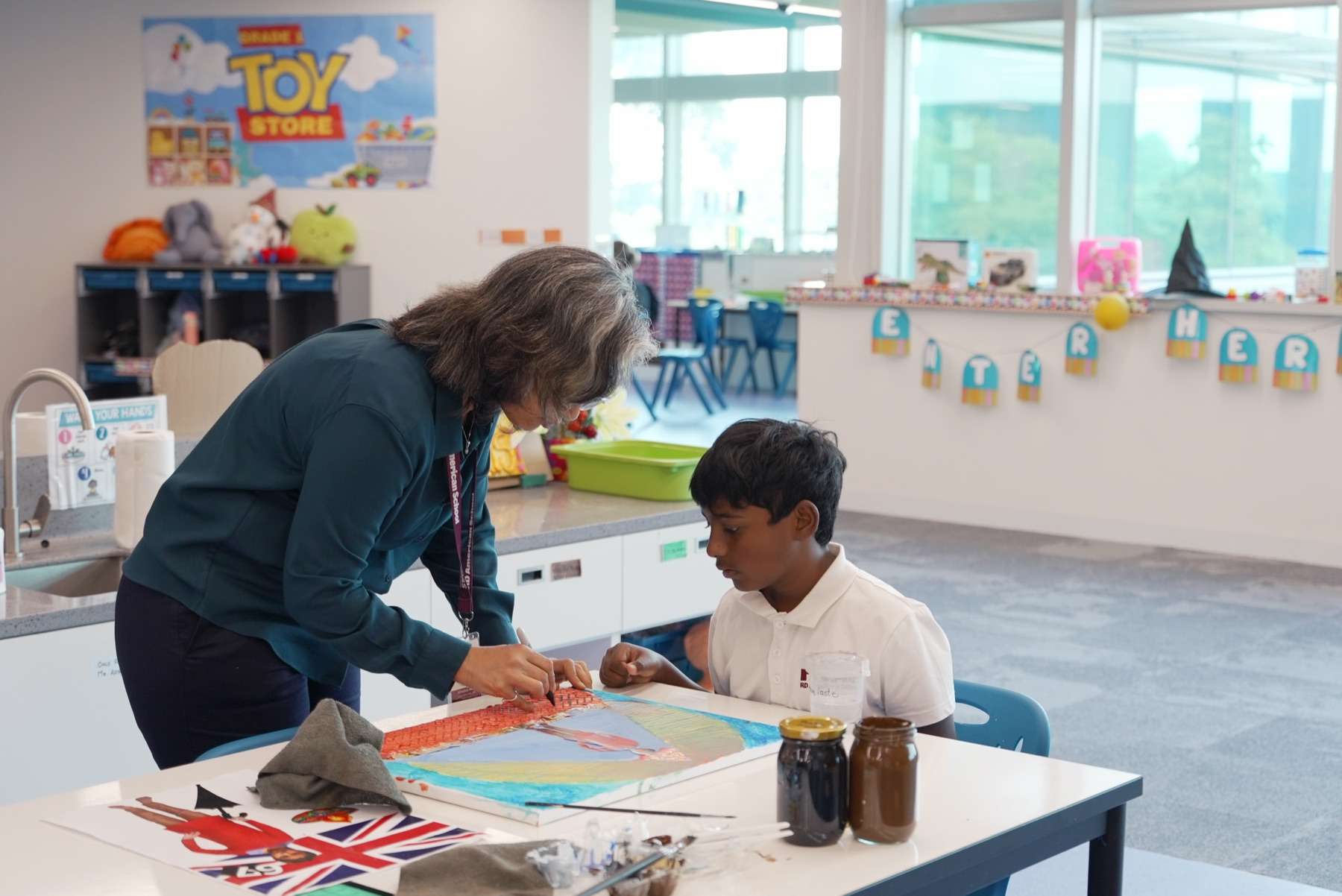
A teacher guides a student painting a vivid beach scene in the art studio
See deeper · Switch stage

One painting: how each stage sees it

    The same work, seen in ever-deeper ways as ability grows: this is what we mean by critical appreciation. Each column shows what that stage asks of a student. By high school, students can identify and name all the visual elements in a work with accuracy and intention, analyze how those elements interact, and explain the decisions behind them and the effects they create.

    “The deepest understanding comes not from teaching,
    but from a child doing it for themselves.”

    Ms. Aparna, Visual Art Teacher

    Every child who moves through this program carries something that does not appear in a portfolio. A habit of observation. A tolerance for uncertainty. The confidence to begin something without knowing exactly how it will end. These are life skills as much as artistic ones, and they begin here, in this room, with a mark on a page.